
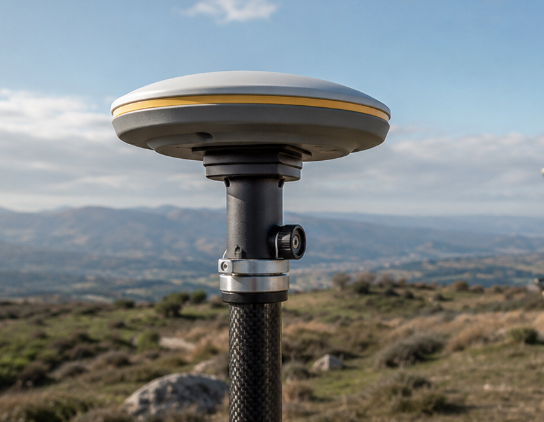
A mushroom head antenna is designed with a low-profile round housing. This shape helps reduce wind resistance and makes it suitable for outdoor use on survey poles, vehicles, drones, and fixed monitoring stations. Compared with ordinary GPS antennas, an RTK GPS surveying mushroom head antenna usually supports multi-frequency and multi-constellation signals, such as GPS, GLONASS, Galileo, and BeiDou. This allows the receiver to get more satellite data and improve positioning reliability in complex environments.
When choosing a mushroom head antenna for RTK surveying, frequency support should be checked first. A good antenna should support the same frequency bands as your GNSS receiver. Common bands include L1, L2, L5, B1, B2, and B3. Wider frequency coverage means better compatibility and stronger performance for professional RTK work.
Signal gain is another key factor. Higher gain can help improve satellite signal reception, especially in areas with trees, buildings, or other signal obstacles. However, gain should not be the only standard. A quality antenna also needs good filtering ability to reduce interference from mobile networks, radio signals, and other electronic devices.
Durability is also important for field surveying. The antenna should have a waterproof and dustproof housing, strong vibration resistance, and stable performance under different weather conditions. For outdoor RTK GPS surveying, an antenna with rugged materials and reliable sealing can reduce downtime and extend service life.
Installation also matters. Before buying, check the connector type, cable length, mounting method, and working voltage. Common connector options include TNC, SMA, and N-type. Choosing the correct connector can save installation time and avoid signal loss caused by poor matching.
A suitable RTK GPS surveying mushroom head antenna can improve positioning stability, reduce signal dropouts, and support more efficient fieldwork. For surveyors, engineers, and system integrators, selecting the right antenna is not just a small accessory decision. It is part of building a reliable GNSS solution.
When comparing products, focus on frequency bands, gain, anti-interference performance, waterproof rating, connector type, and real field compatibility. With the right mushroom head antenna, RTK GPS surveying becomes more stable, accurate, and efficient.