

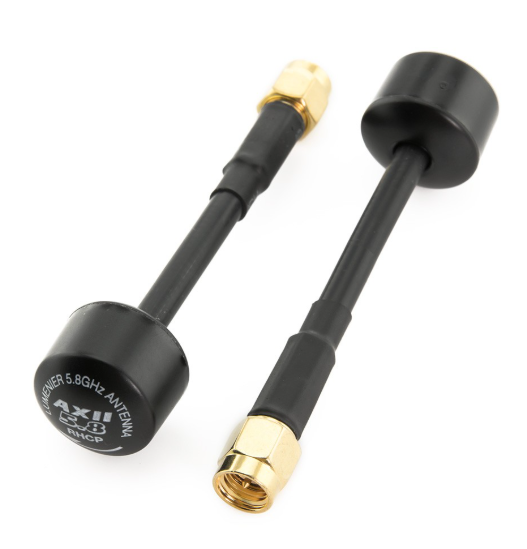
For commercial UAV operators and ELRS 2.4G integrators, securing the command link requires a 2.4ghz mushroom antenna drone remote control setup. Here is the engineering breakdown of why Circular Polarization (CP) is replacing standard linear whips on radio controllers.
1. Eliminating the Tip Null (Dead Zones)
A standard rubber ducky (dipole) antenna radiates energy like a donut. The top and bottom are dead zones. The internal lobes of a premium 2.4GHz mushroom antenna generate a true hemispherical radiation pattern. This completely eliminates the tip null. It guarantees a continuous, unbroken control link regardless of how the pilot holds the radio or how aggressively the UAV maneuvers in the sky.
2. Piercing 2.4GHz Urban Congestion
The 2.4GHz band is globally saturated by Wi-Fi routers, Bluetooth devices, and urban IoT grids. This raw noise drastically reduces your maximum control range. By utilizing a Right-Hand Circular Polarized (RHCP) array inside the mushroom radome, the antenna mathematically filters out standard linear Wi-Fi noise. This CP geometry allows your telemetry and control packets to pierce through heavy urban RF pollution without packet loss.
3. Mechanical Rigidity for Field Work
Radio controllers are constantly shoved into backpacks. Fragile linear antennas snap at the hinge. A premium 2.4G mushroom antenna utilizes a sonic-welded polycarbonate radome and semi-rigid coaxial cable. It withstands physical abuse in the field while maintaining a flawless VSWR (<1.3), ensuring your expensive transmitter module never overheats.
Need Reliable 2.4G Control Hardware? As a direct manufacturer, we mass-produce VNA-swept 2.4GHz mushroom antennas for commercial drone remote controls, ground stations, and ELRS systems. Cut out the trading companies. [Contact Our RF Engineers for B2B Factory Pricing]