

If you fly FPV drones, losing your 5.8GHz video feed behind a tree isn't just annoying—it's a guaranteed crash. Stock linear whip antennas are notorious for picking up reflected signals (multipath interference), which causes your goggles to display heavy static and screen tearing.
To lock in a crystal-clear video feed, professional pilots and UAV manufacturers upgrade to a 4 leaf clover mushroom antenna. But what makes this specific design so critical for 5.8GHz systems?
1. Why Exactly 4 Leaves? (Skew-Planar Wheel)
Inside the plastic "mushroom" dome are four precisely bent copper wire lobes. This is known in RF engineering as a skew-planar wheel design.
Unlike a standard 3-leaf clover, the 4-leaf geometry provides a highly uniform, omnidirectional radiation pattern. More importantly, it generates near-perfect Circular Polarization (RHCP or LHCP). When your 5.8GHz signal bounces off a concrete wall, its circular rotation reverses. The 4-leaf design actively rejects this reversed bounce, completely killing multipath static.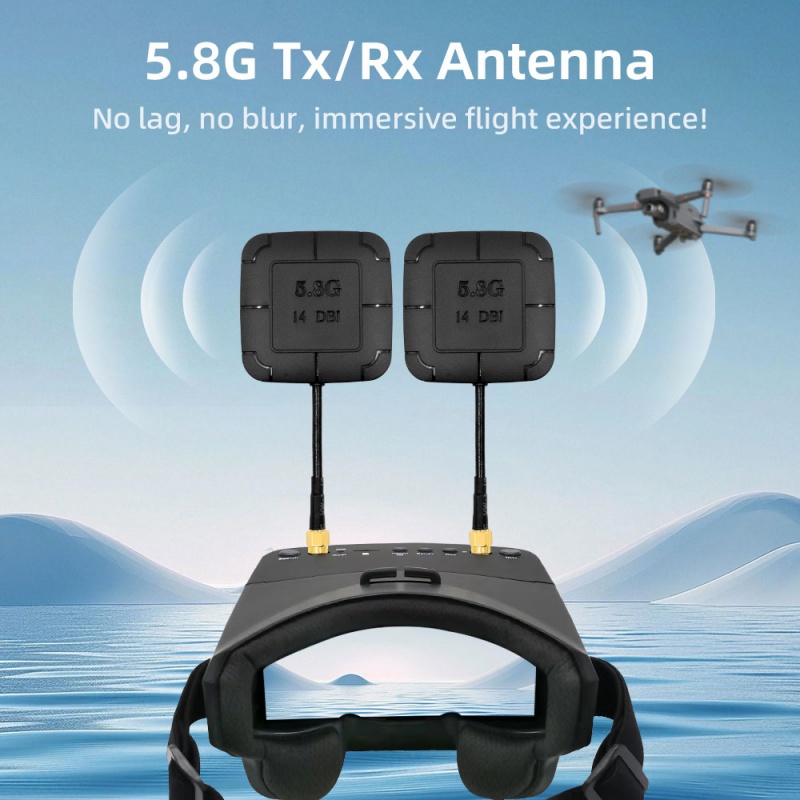
2. Preventing VTX Burnout (VSWR)
A cheap antenna does more than ruin your video range; it can destroy your hardware. If an antenna is poorly tuned, the RF energy doesn't radiate into the air—it reflects back into your Video Transmitter (VTX) as raw heat.
The best 5.8GHz mushroom antennas are individually swept on a Vector Network Analyzer (VNA) to guarantee a VSWR of less than 1.2. This ensures maximum transmission efficiency and keeps your high-power VTX from burning out mid-flight.
3. The Radome: Surviving the Crash
Bare copper cloverleaf antennas get instantly crushed in a crash, permanently ruining their delicate RF tuning. The "mushroom" is actually a sonic-welded plastic radome (typically impact-resistant PC). It protects the internal 4-leaf geometry from branch strikes and hard landings without attenuating the high-frequency signal.