

For professional micro-quad builders, the ultimate upgrade is a mini mushroom antenna for micro drone platforms. Here is the engineering breakdown of how to spec lightweight video hardware without sacrificing RF performance.
1. SWaP Optimization and AUW
In the micro drone sector, All-Up Weight (AUW) is the most critical metric. A standard SMA mushroom antenna can weigh over 10 grams, which is a massive payload penalty for a 35-gram micro drone.
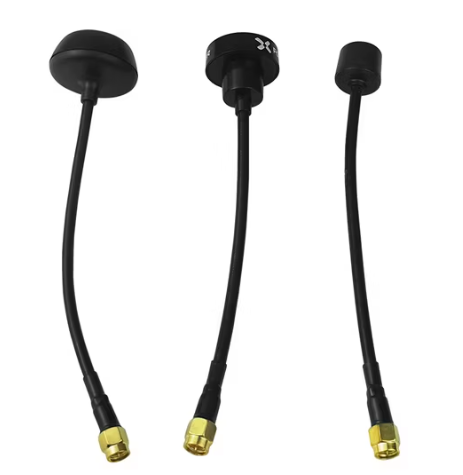
A true "mini" mushroom antenna is aggressively SWaP-optimized (Size, Weight, and Power). By utilizing micro-gauge coaxial cables (like RG178) and scaled-down polycarbonate radomes, these antennas deliver full 5.8GHz resonance while weighing strictly between 1.5g and 2.5g. This preserves the drone's agility and maximizes battery efficiency.
2. Direct IPEX / U.FL Terminations
Micro video transmitters (VTX) do not have the PCB real estate to support heavy, threaded SMA ports. To achieve the absolute lowest weight, a mini mushroom antenna must be terminated with a micro IPEX (U.FL) connector.
This allows the antenna to snap directly onto the VTX board, completely eliminating the need for bulky SMA adapters or heavy pigtail cables.
3. Defeating Indoor Multipath Interference
Micro drones are frequently flown in high-density indoor environments—warehouses, real estate tours, or concrete ducting. Standard linear antennas suffer from extreme multipath interference indoors, causing the video feed to tear and roll when microwave signals bounce off walls.
Despite its tiny size, the mini mushroom radome houses a true Circular Polarized (CP) array. This corkscrew geometry inherently rejects inverted signal bounces, guaranteeing a locked, static-free video feed directly to your FPV goggles, even flying behind concrete pillars.
Need Ultra-Light FPV Hardware? We mass-produce lightweight, VNA-tested mini mushroom antennas designed specifically for micro drones, Cinewhoops, and sub-250g UAV fleets. [Contact Our RF Factory for B2B Wholesale Pricing]