

A classic procurement mistake is buying identical antennas for both ends of the system. Here is the RF engineering breakdown of how professional integrators pair their hardware.
1. The 3-Leaf Cloverleaf (The VTX)
The 3-leaf antenna is traditionally deployed on the drone's video transmitter (VTX). Why? It comes down to weight and radiation efficiency. Three copper lobes generate an excellent Circular Polarized (CP) signal. For a transmitter blasting RF energy into the air, a 3-leaf design is perfectly sufficient. More importantly, it saves critical grams on the drone's All-Up Weight (AUW) compared to adding a fourth copper element and extra solder.
2. The 4-Leaf Skew Planar (The VRX)
The 4-leaf antenna should almost exclusively be mounted on your FPV goggles or ground station receiver (VRX). While the 3-leaf is great for transmitting, it struggles with Axial Ratio perfection. The 4-leaf architecture forces the RF energy into a much tighter corkscrew. This near-perfect Axial Ratio provides massive multipath rejection. When your drone's signal bounces off a concrete wall, the reversed wave hits your receiver. The 4-leaf antenna mathematically rejects that bounced interference, keeping your video feed free of static and screen tearing.
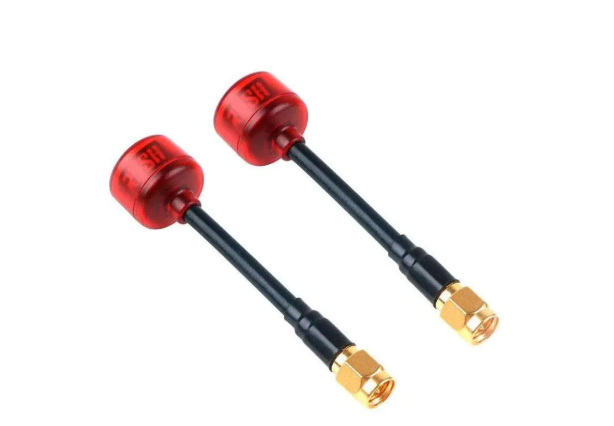
3. The Hardware Integration Rule
For the absolute cleanest 5.8GHz video link without a payload penalty, engineers follow this strict pairing rule:
-
VTX (Drone): Mount a lightweight 3-leaf mushroom antenna.
-
VRX (Ground Station): Mount a precision 4-leaf mushroom antenna.
Need Paired FPV Hardware? We manufacture VNA-swept 3-leaf and 4-leaf mushroom antennas for commercial drone fleets and FPV video integrators. Stop dealing with mismatched sets. [Contact Our RF Factory for B2B Wholesale Pricing]