

Why Connected Vehicles Need Both 5G Communication and High-Precision Positioning?
The rapid development of connected vehicles, intelligent transportation systems, and industrial IoT applications is creating new requirements for vehicle communication technologies. Modern vehicles are no longer only transportation tools; they have become connected platforms that require continuous data transmission, cloud communication, and accurate positioning.
A reliable vehicle communication system must achieve two key goals: stable high-speed wireless connectivity and high-precision location information. Traditional solutions often use separate antennas for cellular communication and GNSS positioning, increasing installation complexity and creating additional challenges for system integration.
The 5G+RTK Vehicle Terminal Antenna provides an integrated solution by combining full-band 5G communication and dual-frequency GNSS RTK positioning in a single compact antenna. This solution supports connected vehicles, fleet management systems, EV charging infrastructure, smart logistics, and industrial IoT applications.
1. The Growing Demand for Integrated 5G and RTK GNSS Antenna Solutions
As smart mobility continues to expand, vehicles require faster communication and more accurate positioning capabilities. Fleet operators need real-time vehicle tracking, logistics companies require reliable route management, and autonomous driving systems depend on precise positioning data.
The combination of 5G connectivity and RTK GNSS technology enables vehicles to maintain stable communication with cloud platforms while achieving centimeter-level positioning accuracy. This makes integrated 5G GNSS antenna solutions increasingly important for automotive IoT, smart transportation, and connected vehicle applications.
Key applications include:
• Fleet tracking and commercial vehicle management
• Electric vehicle charging networks
• Smart city roadside infrastructure
• Industrial IoT gateways
• Autonomous and assisted driving systems
2. What Is a 5G+RTK Vehicle Terminal Antenna?
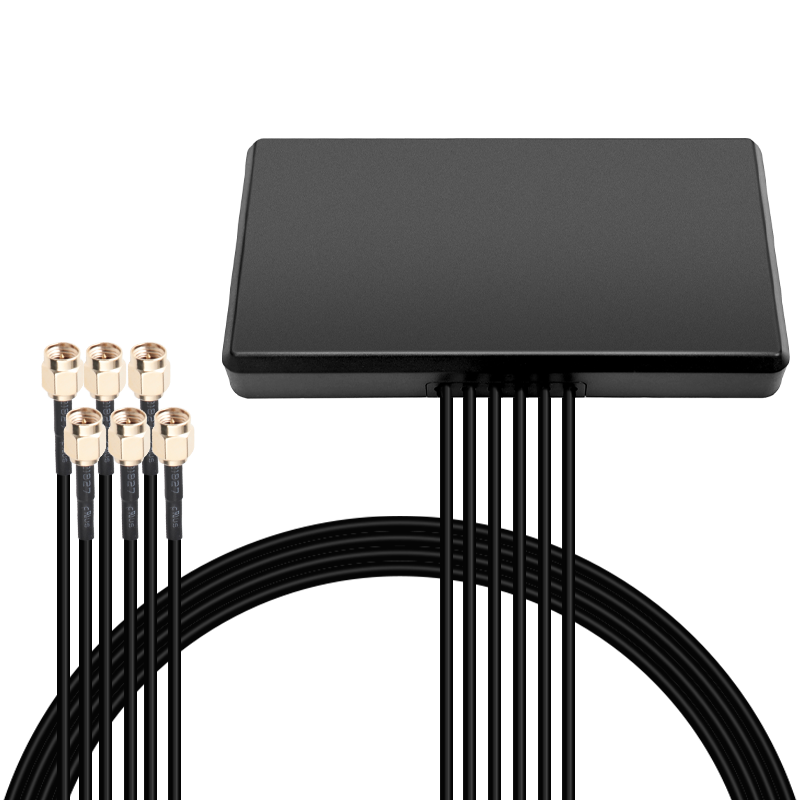
A 5G+RTK Vehicle Terminal Antenna is a multi-functional antenna solution designed for modern connected mobility applications. It integrates cellular communication and satellite positioning functions into a single compact housing.
Unlike traditional antenna configurations requiring multiple installation points, an integrated 5G RTK antenna simplifies wiring, reduces installation space, and improves overall system reliability.
The antenna supports:
• Full-band 5G/LTE communication coverage
• GNSS L1/L5 dual-frequency reception
• High-precision RTK positioning
• Outdoor industrial deployment
• Vehicle and cabinet-mounted applications
3. Key Features of 5G RTK Vehicle Antenna Solutions
3.1 Full-Band 5G Coverage for Reliable Wireless Communication
The antenna covers the 600-6000 MHz frequency range, supporting modern cellular communication requirements including 5G NR, LTE, and private network applications.
Full-band coverage allows equipment manufacturers to develop flexible connected vehicle solutions for different global markets while maintaining stable wireless performance.
3.2 Dual Frequency GNSS L1/L5 for High Precision Positioning
Supporting GNSS L1 and L5 frequencies improves positioning performance in challenging environments. Dual-frequency GNSS technology provides better multipath rejection, faster convergence, and improved positioning stability in urban areas where buildings and obstacles may affect satellite signals.
This makes the antenna suitable for RTK positioning applications requiring higher accuracy and reliability.
3.3 High Gain and Strong Anti-Interference Performance
The integrated antenna design provides optimized RF performance with high gain, stable phase characteristics, and strong interference resistance. Built-in LNA technology helps maintain GNSS signal quality and reduces the risk of positioning interruptions in complex electromagnetic environments.
3.4 IP65 Waterproof Design for Outdoor Applications
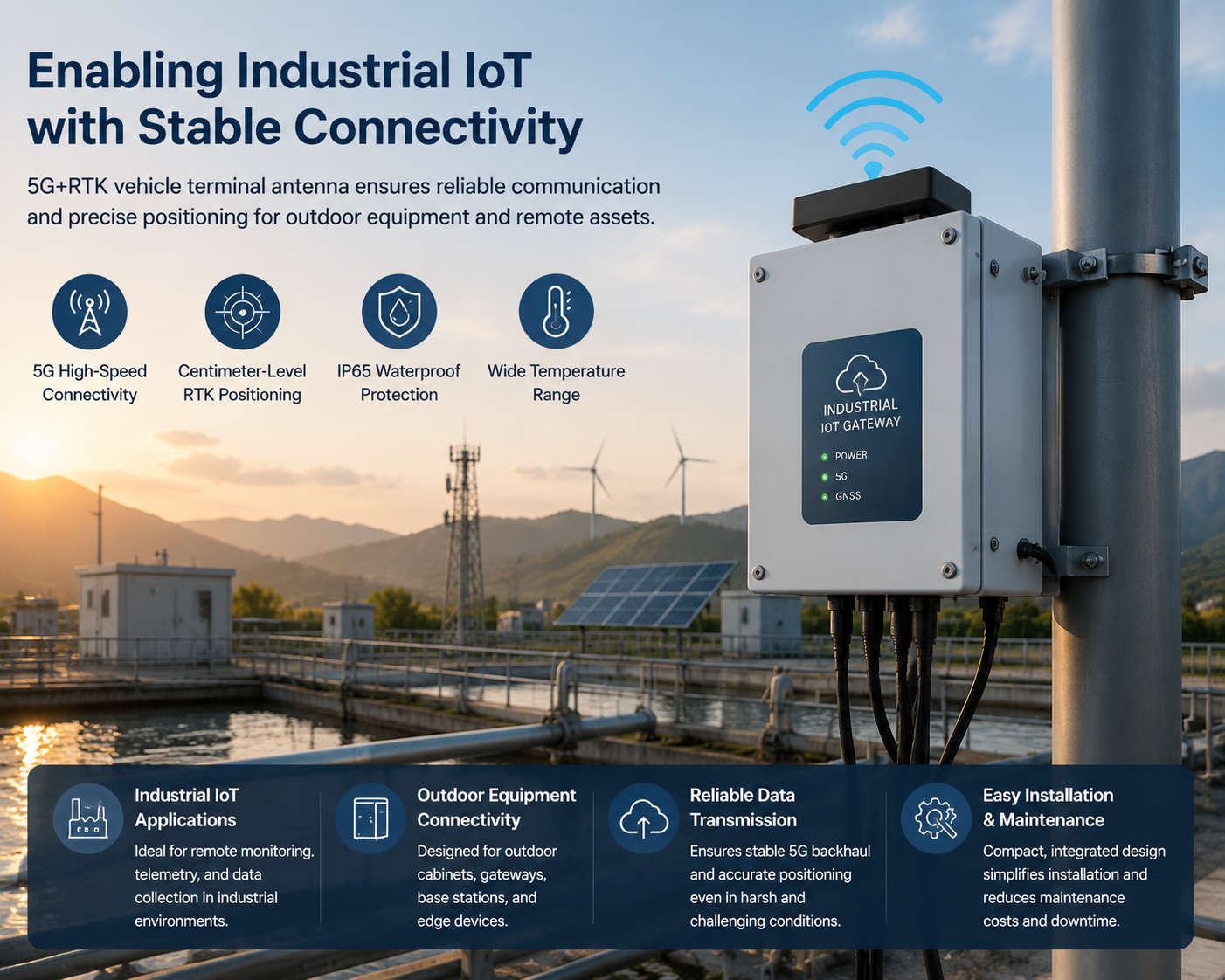
Designed for outdoor environments, the antenna features IP65 protection and reliable operation from -30°C to +70°C. It can withstand rain, dust, sunlight, and temperature variations, making it suitable for EV charging stations, outdoor communication cabinets, and roadside infrastructure.
4. Why Integrated 5G GNSS Antennas Are Better Than Traditional Solutions
Compared with separate cellular and GNSS antennas, integrated 5G RTK antenna solutions offer:
• Reduced installation complexity
• Fewer cables and connection points
• Better space utilization
• Lower electromagnetic interference risks
• Easier maintenance and replacement
For manufacturers developing connected vehicles and industrial wireless equipment, an integrated antenna design provides a more efficient path from product development to mass production.
5. Application Scenarios
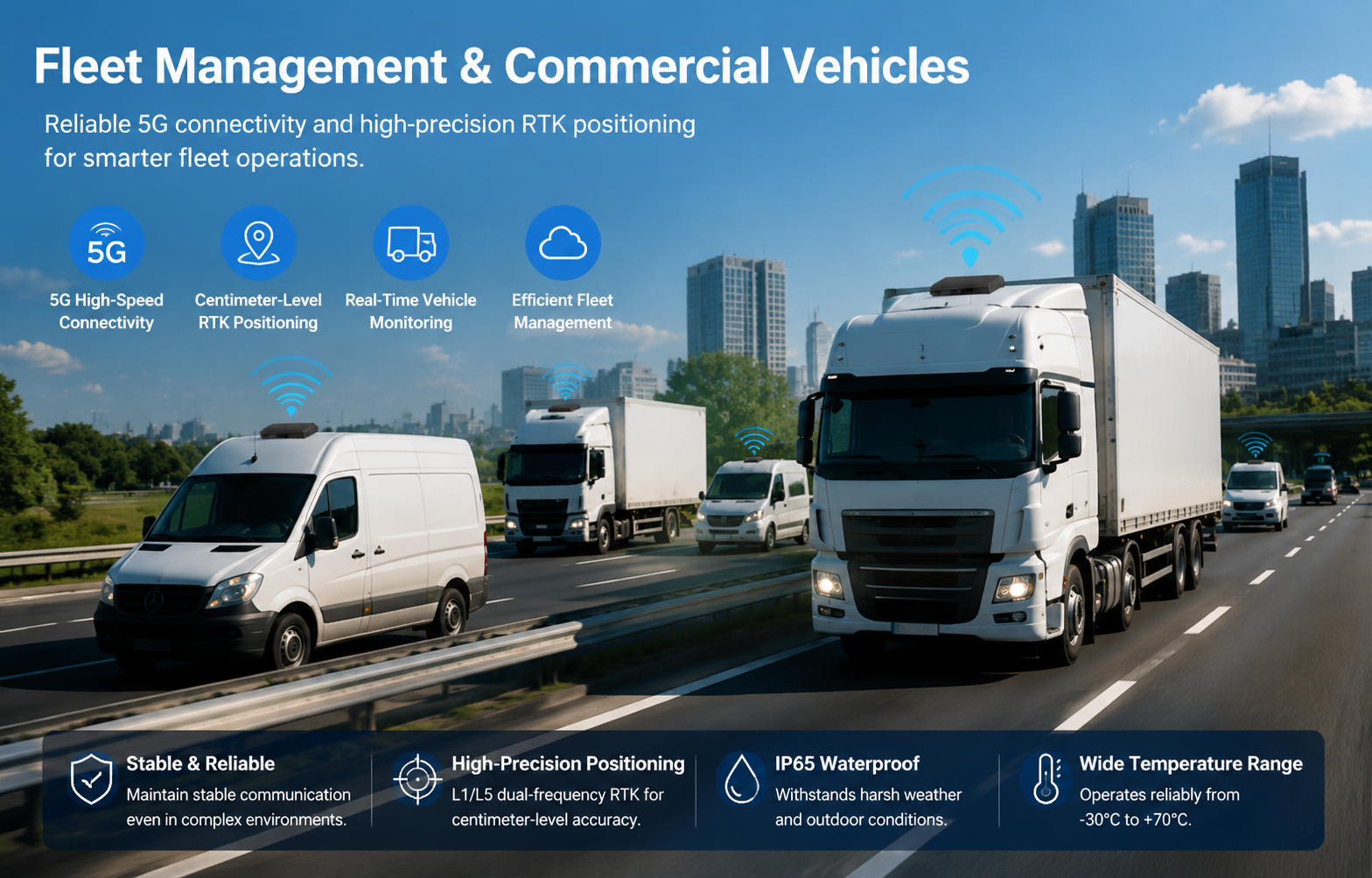
Fleet Management and Commercial Vehicles:
Supports vehicle tracking, route planning, real-time monitoring, and cloud-based fleet management.
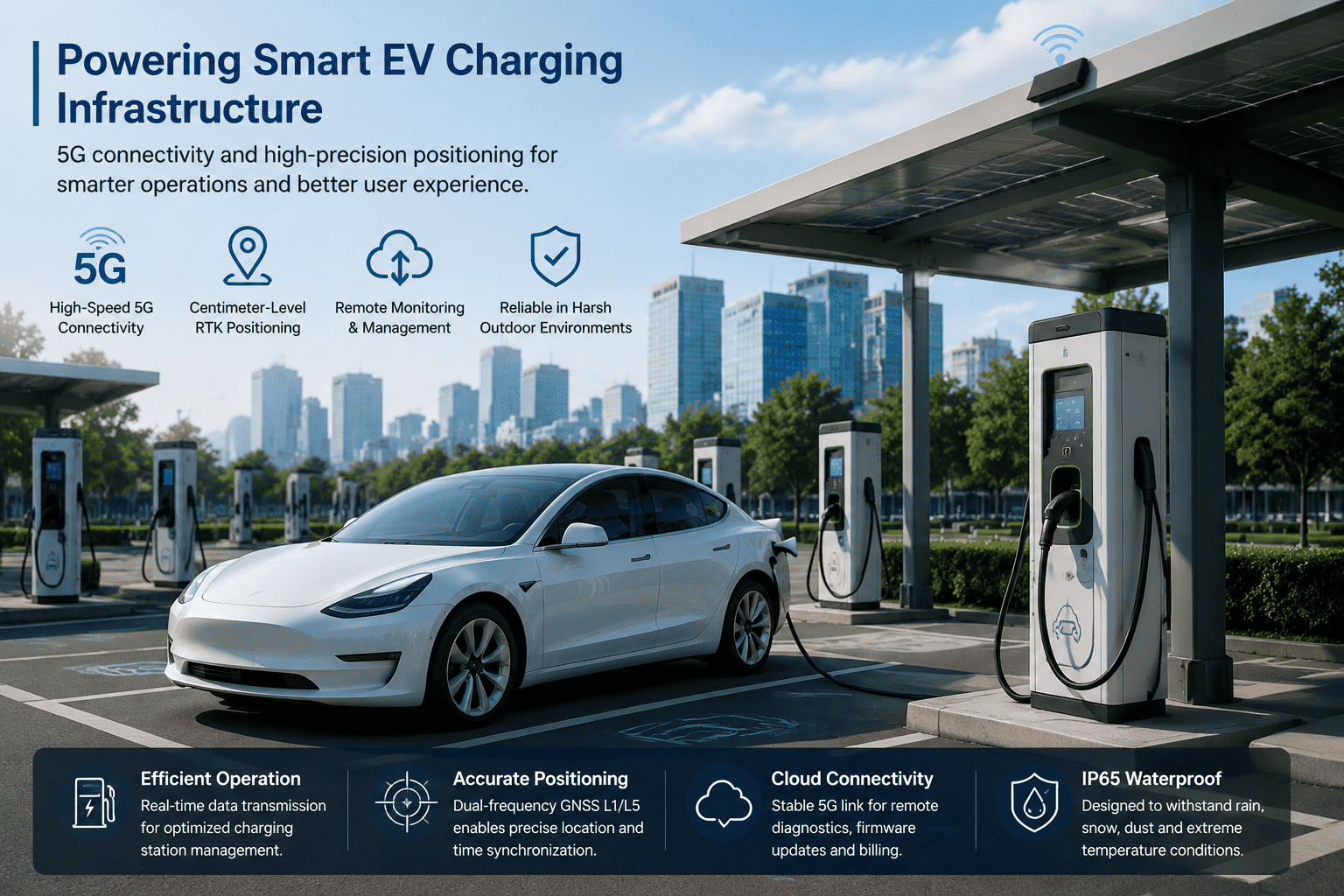
Electric Vehicle Charging Infrastructure:
Enables reliable 5G connectivity for charging station monitoring, remote diagnosis, and smart energy management.
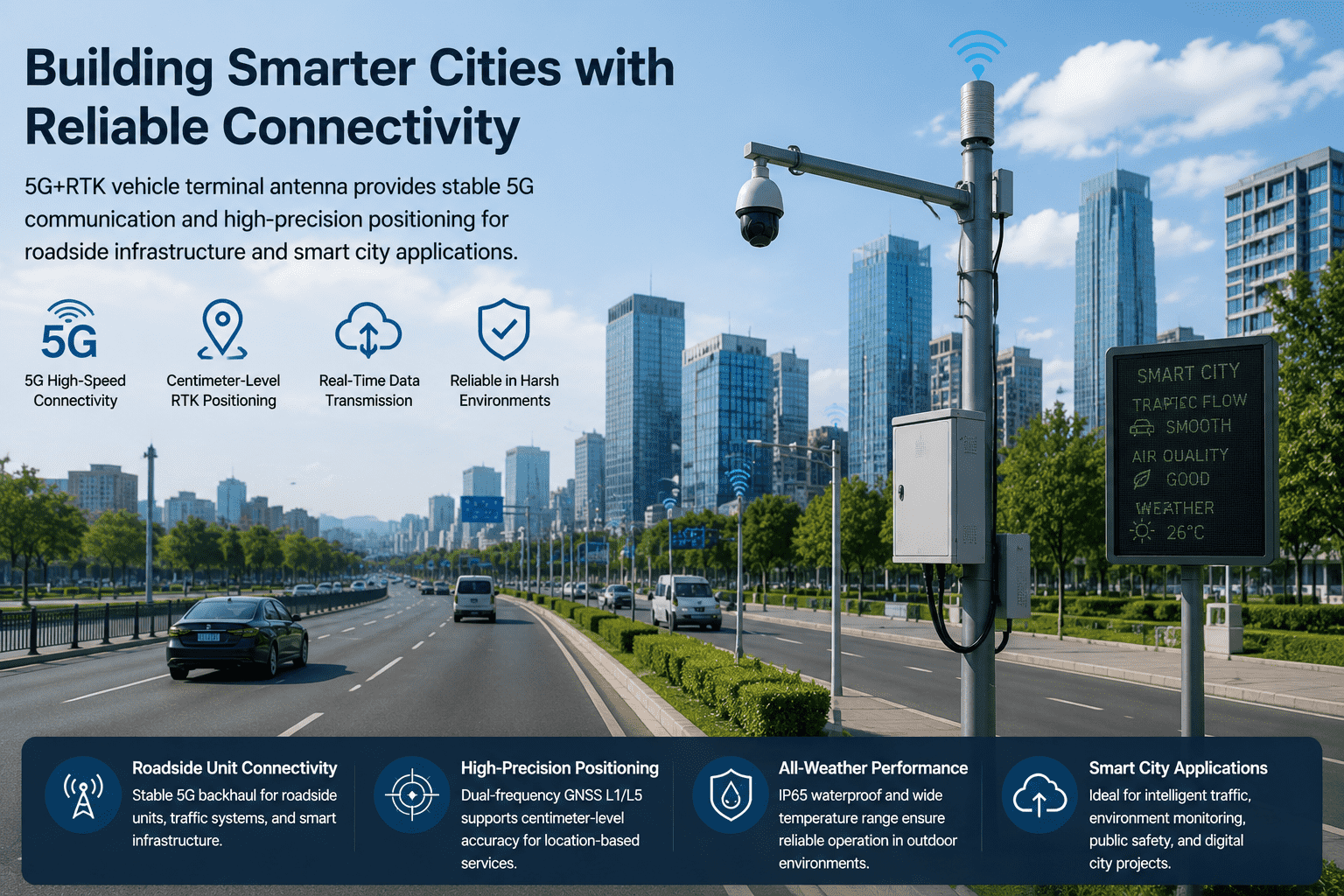
Smart City and Roadside Infrastructure:
Provides communication and positioning support for roadside units and intelligent transportation systems.
Industrial IoT Applications:
Supports outdoor gateways, communication cabinets, and wireless monitoring equipment.
6. Engineering Considerations When Selecting a 5G RTK Antenna
Engineers should evaluate frequency coverage, cable loss, installation location, grounding protection, and environmental requirements when selecting an antenna.
Important considerations include:
• 600-6000 MHz 5G coverage
• GNSS L1/L5 compatibility
• SMA/TNC standard interfaces
• Low-loss cable selection
• Outdoor protection requirements
7. Technical Specifications
Frequency:
5G: 600-6000 MHz
GNSS L1: 1575.42 MHz
GNSS L5: 1176.45 MHz
Gain: 5-6 dBi
VSWR: <1.8
Efficiency: 35%-80%
Protection Rating: IP65
Operating Temperature: -30°C to +70°C
Interface: SMA internal thread with internal pin
Dimensions: 158×90 mm
8. Future Trends: 5G, GNSS and Connected Mobility
The future of transportation will rely increasingly on connected vehicle technologies, V2X communication, autonomous driving, and intelligent logistics.
Integrated 5G GNSS antenna solutions will become a key component in smart mobility ecosystems by providing reliable communication and precise positioning in a compact and scalable design.
Frequently Asked Questions
What is a 5G+RTK vehicle antenna?
5G+RTK vehicle antenna combines cellular communication and GNSS RTK positioning in one integrated antenna solution.
Why do vehicles need both 5G and GNSS antennas?
5G provides high-speed data communication while GNSS provides accurate location information.
What applications use 5G RTK antennas?
Applications include fleet management, EV charging, smart transportation, autonomous vehicles, and industrial IoT.
Can the antenna be customized?
Yes. Antenna frequency, cable length, connector type, and mechanical design can be customized.
Does the antenna support outdoor installation?
Yes. The IP65 design supports outdoor environments and harsh operating conditions.
Need a Customized 5G RTK Antenna Solution?
YS ANTENNA provides professional antenna design and manufacturing services for connected vehicles, EV charging infrastructure, fleet management systems, and industrial IoT applications.
Request a Quote and contact our antenna engineers for customized solutions.