

Why Antenna Design Matters More in Modern IoT Devices?
The rapid growth of Industrial IoT (IIoT), smart home systems, remote monitoring equipment, and connected devices is driving a new generation of wireless products that require smaller size, higher integration, and more reliable connectivity.
For many IoT manufacturers, selecting the right antenna is one of the most critical decisions during product development. A poorly designed antenna can lead to unstable connections, reduced communication distance, failed certification tests, and costly redesigns.
As devices become smaller, traditional external antennas are often difficult to integrate due to limited installation space and strict mechanical requirements. This is why compact embedded antennas, especially 4G LTE PCB antennas, are becoming increasingly popular for modern wireless terminals.
Designed for space-limited applications, PCB antennas offer engineers a flexible solution that combines compact form factor, easy integration, and reliable cellular communication performance.
The Growing Demand for Compact LTE Antenna Solutions
Modern IoT products are expected to provide continuous wireless communication while maintaining smaller form factors.
Applications such as:
Smart gateways
Industrial controllers
Remote monitoring systems
Smart meters
Security devices
Portable terminals
Connected home equipment
Require stable LTE connectivity in environments with limited installation space.
However, engineers often face several challenges:
Limited Internal Space
Many IoT devices have compact housings with limited room for antenna placement.
Traditional external antennas may increase product size and affect industrial design.
Complex RF Environments
Battery modules, metal components, PCBs, and plastic enclosures can affect antenna performance.
Antenna efficiency depends not only on the antenna itself but also on the complete device structure.
Faster Product Development Cycles
Manufacturers need antenna solutions that can quickly move from prototype validation to mass production.
This requires professional RF design support and testing capability.
What Is a 4G LTE PCB Antenna?
A 4G LTE PCB antenna is an embedded antenna solution directly mounted onto a device PCB through surface-mount technology or solder connection.
Unlike traditional external antennas, PCB antennas are integrated inside the device enclosure, helping manufacturers achieve:
Smaller product dimensions
Simplified assembly
Lower manufacturing cost
Better product appearance
Higher integration
For cellular IoT devices, PCB antennas provide reliable LTE communication across multiple frequency bands while maintaining a compact footprint.
YINGSHUN ANTENNA's 7013 is a compact surface-mount PCB antenna designed for 4G/LTE IoT terminals requiring reliable wireless performance in limited installation spaces.
The antenna covers a wide frequency range from 700 MHz to 2700 MHz, supporting common LTE low, mid, and high-frequency bands, including:
B28
B20
B8
B3
B1
B7
This wide-band capability enables a single antenna solution to support multiple cellular networks and regional applications.
Key Specifications
Parameter Specification
Frequency Range 700–2700 MHz
Antenna Type Surface Mount PCB Antenna
Size 70 × 13 mm
Gain Approx. 3.0 dBi
VSWR <1.8
Impedance 50Ω
Polarization Omnidirectional
Maximum Power 33 dBm
Operating Temperature -30°C to +70°C
The compact 70 × 13 mm structure makes it suitable for applications where PCB space is limited while maintaining stable wireless connectivity.
Key Advantages of Compact 4G LTE PCB Antennas
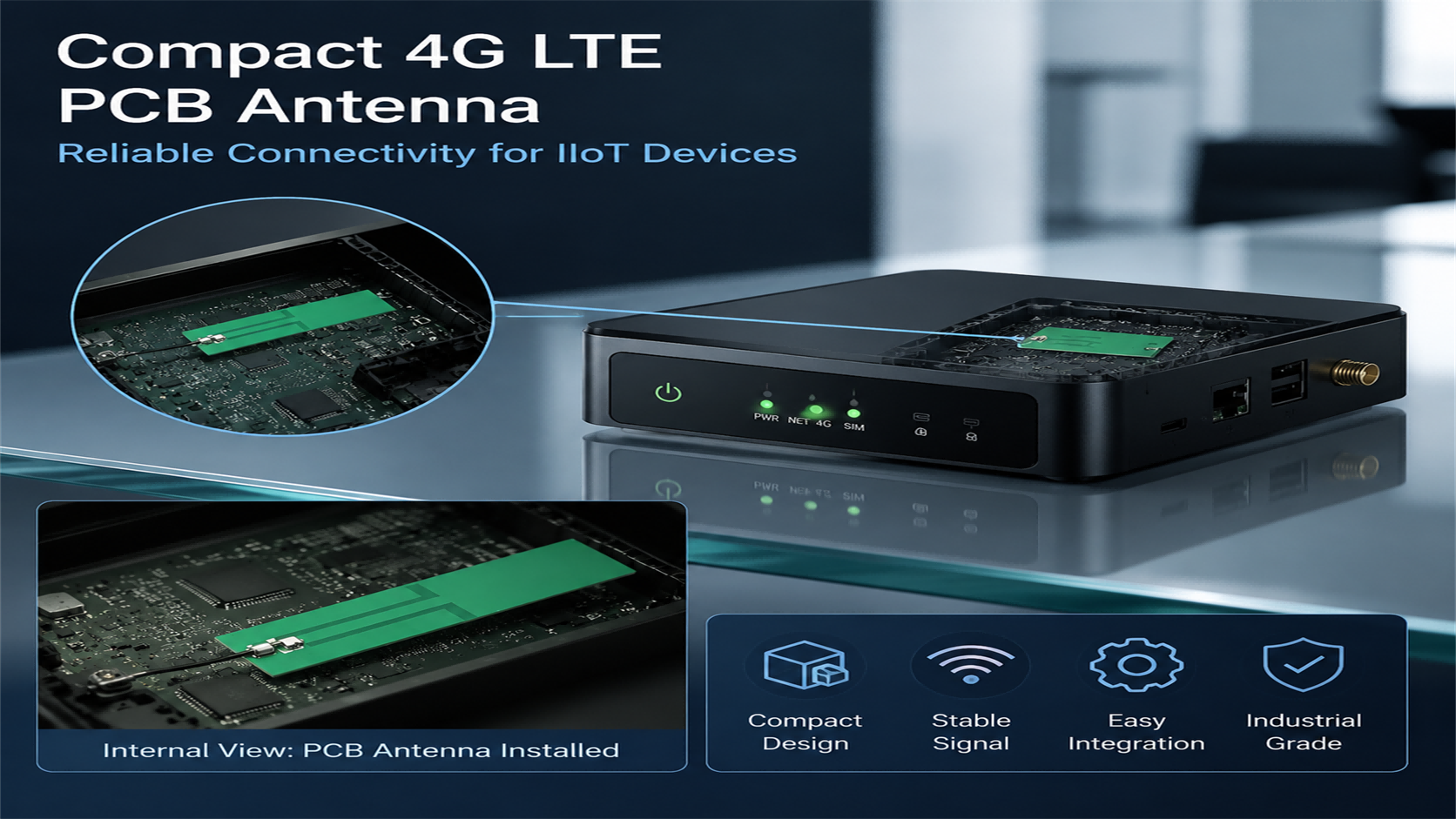
1. Space-Saving Embedded Design

One of the biggest advantages of PCB antennas is their compact integration capability.
By mounting directly onto the motherboard, manufacturers can reduce external components and optimize product structure.
This makes them ideal for:
IoT gateways
Smart sensors
Industrial controllers
Portable wireless devices
The 7013 uses a direct solder connection design, allowing seamless integration with device PCBs.
2. Wide Frequency Coverage for Global IoT Deployment
Different regions use different LTE frequency bands.
A wide-band LTE antenna reduces product complexity by supporting multiple networks with one antenna design.
The 700–2700 MHz coverage allows manufacturers to develop products for various markets without creating multiple antenna versions.
3. Stable Omnidirectional Communication
IoT devices are often installed in changing environments where orientation cannot always be controlled.
An omnidirectional radiation pattern helps maintain stable communication performance when devices rotate, move, or operate in complex environments.
This is especially valuable for:
Industrial monitoring devices
Mobile terminals
Smart tracking systems
4. Easy RF Optimization Before Mass Production
Antenna performance depends heavily on the complete device design.
Factors including:
PCB layout
Ground plane design
Housing materials
Battery position
Metal components
Can influence RF performance.
During development, engineers should evaluate:
VSWR
S11 parameters
Antenna efficiency
OTA performance (TRP/TIS)
Before final mass production.
YINGSHUN ANTENNA supports antenna tuning and optimization based on real device conditions.
Typical Applications of 4G LTE PCB Antennas

Smart IoT Gateway
Smart gateways require stable cellular communication to connect sensors, devices, and cloud platforms.
Compact PCB antennas help maintain reliable LTE connections while keeping gateway designs compact.
Industrial Control and Remote Monitoring
Industrial RTU systems, environmental monitoring equipment, and security systems often operate in remote locations.
Reliable LTE connectivity ensures continuous data transmission and remote management.
Smart Home Devices
Connected home products require small internal antenna solutions that can fit into compact enclosures.
PCB antennas provide a clean integration approach without affecting product appearance.
Engineering Considerations When Integrating a PCB Antenna
PCB Layout Optimization
The antenna should be placed near the PCB edge with sufficient clearance from:
Battery components
Metal shields
Screws
Other conductive materials
A proper ground reference area is important for maintaining antenna efficiency.
Matching and Tuning
Before mass production, RF engineers should optimize the matching network based on the final assembled device.
A professional tuning process helps achieve:
Better signal quality
Improved transmission efficiency
More stable production consistency
Housing Impact Evaluation
The device enclosure can affect antenna resonance.
Plastic thickness, dielectric materials, and nearby metal structures may influence final performance.
Therefore, antenna testing should always be performed with the complete product assembly.
Why Choose YINGSHUN ANTENNA for Custom PCB Antenna Solutions?

As a professional antenna manufacturer, YINGSHUN ANTENNA provides complete wireless development support, including:
Antenna Selection
Helping engineers choose the most suitable antenna according to:
Frequency requirements
Device structure
Application environment
RF Design Support
Optimizing antenna performance through engineering analysis and tuning.
Prototype Development
Supporting rapid sampling and verification before production.
Mass Production Support
Ensuring stable quality and consistent supply for long-term projects.
Conclusion: Compact Antenna Solutions Enable Smarter IoT Products
As IoT devices continue to become smaller and more connected, antenna integration has become a key factor affecting product success.
A compact 4G LTE PCB antenna provides manufacturers with an efficient solution for achieving reliable cellular connectivity while saving valuable internal space.
With wide-band coverage, embedded design, and professional RF optimization support, PCB antennas are becoming an essential component for next-generation IoT devices.
YINGSHUN ANTENNA helps global customers transform wireless concepts into reliable production-ready solutions.
Need a Customized 4G LTE Antenna Solution?
Our RF engineers can support your project with:
✓ Antenna selection
✓ PCB layout optimization
✓ RF tuning
✓ Prototype testing
✓ Mass production support
Request Engineering Support →