1. Why Do Military Systems Favor Spiral Antennas?
In military communications, electronic warfare, UAVs, and precision guidance, antennas must maintain stable performance over an extremely wide frequency range while surviving harsh environments. Spiral antennas have become a dominant choice in the defense sector due to their inherent broadband characteristics and circular polarization capability.

2. Operating Principle and Key Parameters of Spiral Antennas
Spiral antennas typically consist of two or more metallic arms wound in a logarithmic or Archimedean spiral pattern. When a signal is fed, the current travels outward along the arms, radiating at specific frequencies. Due to its self-complementary structure, the antenna’s impedance and radiation pattern remain nearly constant over a wide bandwidth.
Key Parameters in Design:

3. Core Design Requirements for Military Spiral Antennas
3.1 Environmental Durability
Military standards (e.g., MIL-STD-810) impose strict requirements for temperature, shock, vibration, salt fog, and fungus. Spiral antennas must use weather-resistant dielectric materials (such as polyimide or ceramic-filled PTFE) and sealed structures to operate reliably from -55°C to +125°C and withstand high‑G shocks.
3.2 High-Power Handling and PIM Control
In radar or electronic warfare systems, antennas may simultaneously transmit and receive high-power signals. Low passive intermodulation (PIM) design is critical, requiring high‑purity conductors, non‑magnetic platings, and precision interface surfaces to avoid spurious interference.
3.3 Anti-Jamming and Multi‑Mode Applications
Modern military platforms commonly employ anti‑jamming technologies, such as Controlled Reception Pattern Antennas (CRPA). With stable phase centers and circular polarization, spiral antennas can be arrayed and combined with spatial filtering algorithms to effectively suppress interference sources.

4. Custom Capabilities: Why Standard Products Fall Short for Military Needs
Military programs often have highly specific requirements:
-
Constrained form factors: Antennas must be embedded into missile bodies, UAV wings, or armored vehicle roofs.
-
Special frequency combinations: Simultaneous coverage of L‑band (SATCOM) and X/Ku‑band (radar data links) may be required.
-
Low Radar Cross‑Section (RCS): Stealth platforms demand conformal integration and absorber materials.
As a company with full‑chain capabilities in R&D, design, and manufacturing, we provide end‑to‑end custom services—from simulation optimization to prototyping and mass production—based on the customer’s mechanical interfaces, electrical specifications, and environmental ratings.
5. Testing and Quality Assurance: Essential Steps to Meet Military Standards
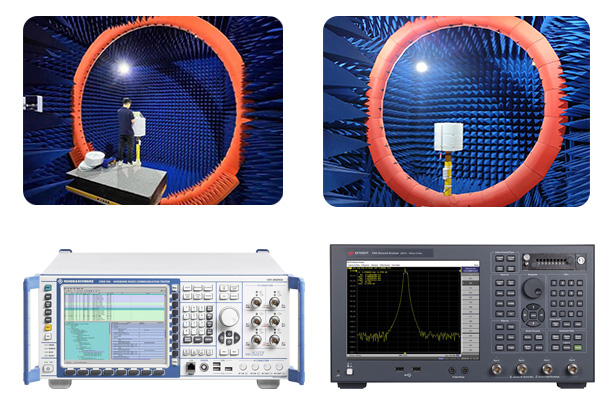
Military products require 100% traceability. Each spiral antenna we ship comes with a complete test report, including:
VSWR full‑band sweep
Gain and efficiency measurement (comparison with standard gain antennas)
Axial ratio and circular polarization purity (measured by rotating a linearly polarized source in an anechoic chamber)